
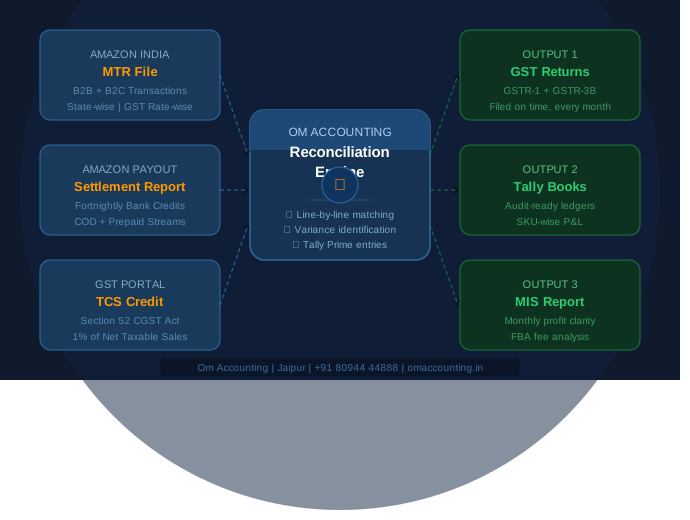
Amazon Seller Accounting Services India is a specialised field — and if your accountant has never opened an Amazon MTR file, your books are probably wrong.
Here is the reality most sellers discover too late. The fortnightly deposit Amazon makes into your bank account is not your revenue. It is a net figure after the platform has deducted referral commissions, FBA fulfilment fees, advertising charges, storage costs, return processing fees, and TCS (Tax Collected at Source) under GST — all in a single transfer. Recording that deposit as “Amazon income” in your accounts is one of the most common and costly bookkeeping mistakes Indian ecommerce sellers make.
At Om Accounting, we have been providing professional Amazon seller accounting services in India for over 15 years. Our team has handled accounts for 100+ active clients across 50+ cities — from individual Amazon sellers in Jaipur and Surat to multi-category brands in Delhi, Mumbai, and Bangalore. We know exactly how Amazon India’s settlement system works, how to reconcile an MTR file line by line, and how to ensure your GST returns reflect what actually happened on the platform.
This page explains our complete Amazon accounting service — what we do, why it matters, and how we work.
Table of Contents
Why Amazon Accounting Is Not Regular Bookkeeping
Traditional bookkeeping works on a simple principle: money comes in, money goes out, record both. Amazon selling breaks this model at every step.
When a customer places an order on Amazon India, the following happens before you receive a single rupee:
- Amazon issues an invoice to the customer on your behalf
- Amazon deducts its referral fee (5% to 15% depending on category)
- If you use FBA, Amazon deducts fulfilment and storage fees
- Any advertising spend from your Sponsored Products campaign is deducted
- Return processing fees are charged if the customer returns an FBA order
- Amazon deducts TCS at 1% of your net taxable value under Section 52 of the CGST Act
- The remaining amount is pooled across multiple orders into a fortnightly settlement
None of these deductions appear in your bank statement with any explanation. They exist only inside Amazon’s settlement report and MTR file — two documents that require specialist knowledge to interpret correctly.
A general accountant who does not regularly work with Amazon seller accounts will either create a single entry for the bank deposit or spend hours trying to decode the files. We have seen clients come to us after months — sometimes years — of incorrect bookkeeping. The damage shows up in wrong GST returns, missed TCS credits, and a P&L statement that bears no resemblance to what the business actually earned.
Amazon seller accounting services in India require platform-specific expertise. That is the gap Om Accounting fills.
Our Amazon Seller Accounting Services
1. Amazon MTR Reconciliation — State-Wise and GST Rate-Wise
The Merchant Tax Report (MTR) is the most important financial document Amazon provides to Indian sellers. It contains every B2B and B2C transaction for a given month, showing the state of the buyer, the applicable GST rate, the taxable value, and the GST amount broken down into CGST, SGST, and IGST.
Our Amazon MTR reconciliation process matches this data against your Tally Prime ledgers, transaction by transaction. We verify:
- Total taxable value by state (to confirm place of supply compliance)
- GST breakup accuracy — CGST, SGST for intra-state and IGST for inter-state
- Credit note entries for returns matched against original sale invoices
- Any variance between MTR data and what is recorded in Tally, with a clear explanation of the difference
If your MTR reconciliation is not done correctly, your GSTR-1 filing will contain errors. Errors in GSTR-1 create mismatches in your B2B customers’ GSTR-2A, which can trigger compliance notices and damage your business relationships. We make sure that does not happen.
2. Amazon Settlement Statement Reconciliation
Amazon generates a settlement report for every payment cycle — typically once a fortnight. This report contains gross sales, all deductions, and the net transfer to your bank account. We reconcile this settlement report against your actual bank credits to verify that every payment matches.
For sellers with multiple seller accounts — for example, a separate account for COD/NEFT payments and another for Prepaid/IMPS transactions — we reconcile both payment streams separately and produce a consolidated five-sheet MIS workbook that shows the complete picture.
This reconciliation routinely uncovers:
- Settlement amounts that do not match bank credits due to Amazon processing errors
- Deductions charged at incorrect rates
- Pending reimbursements from lost or damaged FBA inventory
- Unclaimed credits from cancelled orders that were never settled
Many Amazon sellers are owed between ₹10,000 and ₹80,000 per year in unclaimed reimbursements simply because nobody is tracking the settlement data closely. Our reconciliation process ensures nothing is missed.
3. TCS Reconciliation Under GST — Claim Every Rupee You Are Owed
Under Section 52 of the CGST Act, Amazon India is required to collect Tax at Source at 1% of your net taxable sales on the platform. This TCS is deducted from your payout and deposited with the government under your GSTIN. It appears in your GSTR-2A every month as a credit that you can set off against your GST liability.
But there is a catch. TCS credit does not auto-apply. You must manually accept it on the GST portal each month. If you miss this step, the credit accumulates in your electronic cash ledger unclaimed — effectively giving the government an interest-free loan of your own money.
On ₹50 lakh annual Amazon sales, unclaimed TCS adds up to ₹50,000 per year sitting unused. Our TCS reconciliation process verifies the TCS amount in your GSTR-2A against what Amazon actually deducted, ensures your GSTIN is correctly registered with Amazon Seller Central, and handles the monthly acceptance so your credits are never missed.
4. FBA Fee Analysis and SKU-Level Profitability
Do you know which products in your Amazon catalogue are actually making money after all platform costs?
Most sellers know their selling price and their product cost. Very few know the true margin after accounting for FBA fulfilment fees, storage fees, Sponsored Products advertising spend, return rates, and return processing costs. We build a SKU-level profitability report that shows exactly this — for every active product in your catalogue.
The report breaks down:
- Gross revenue per SKU for the month
- Referral commission per SKU
- FBA fulfilment and storage fees per SKU
- Advertising spend per SKU (mapped from your campaign reports)
- Return rate and total cost of returns per SKU
- Net profit per SKU before and after tax
This is the report that drives real business decisions. We regularly help clients discover that 30% of their SKUs are contributing 90% of their profits — and that several products they thought were selling well are actually loss-making once FBA fees and return costs are factored in. That kind of insight pays for an entire year of accounting services in a single month.
5. GSTR-1 and GSTR-3B Filing for Amazon Sellers
Amazon selling creates GST compliance requirements that are different from offline businesses in several important ways:
- GST registration is mandatory for all Amazon sellers regardless of annual turnover, under Section 24(ix) of the CGST Act
- B2C sales must be reported state-wise in GSTR-1 for inter-state supplies above ₹2.5 lakh
- B2B sales must be reported invoice-by-invoice with the buyer’s GSTIN
- Returns and credit notes must be reflected correctly in the filing period
- TCS credit from Amazon must be claimed in GSTR-3B after reconciling with GSTR-2A
We prepare and file your GSTR-1 and GSTR-3B every month using data reconciled directly from your Amazon MTR — not estimated from bank statements. Every figure is traceable to source data.
For sellers registered in multiple states with multiple GSTINs, we manage each registration separately and maintain a compliance calendar so no filing deadline is ever missed.
6. Tally Prime Bookkeeping for Amazon Sellers
All our accounting work is done in Tally Prime — India’s most widely used accounting software and the preferred tool for businesses that need audit-ready books. We set up a correct ledger structure for Amazon sellers that includes:
- Separate sales ledgers for each GST rate (5%, 12%, 18%, 28%)
- Credit note ledgers for return transactions
- Individual expense ledgers for Amazon commission, FBA fees, advertising, and storage
- A TCS receivable ledger (treated as a tax asset, not an expense)
- Bank reconciliation entries matching every settlement credit
If you are currently maintaining accounts in Excel or with a general accountant using basic software, migrating to a Tally-based system built specifically for your Amazon business gives you clean, audit-ready books from the first month.
7. Monthly MIS Reports — Know Your Numbers Every Month
Every month, we deliver a structured MIS report that gives you a complete view of your Amazon business performance. This is not a raw data file — it is an interpreted, actionable report that includes:
- Gross and net sales for the month (after returns)
- All platform costs — commission, FBA, advertising, storage
- Net profit before and after tax
- Month-on-month comparison (this month vs. last month vs. same month last year)
- SKU performance highlights — top earners, poorest performers, products with high return rates
- Cash flow summary — what came in, what went out, what is outstanding with Amazon
This is the report you use to plan your next inventory purchase, decide which products to push in advertising, and answer your CA’s questions at year-end without spending three days digging through files.
Common Amazon Accounting Mistakes We Fix
When new clients come to us, we almost always find at least one of these errors in their existing books:
Recording the settlement deposit as revenue. The settlement amount is net of all fees and TCS. Recording it as revenue understates your actual sales and distorts your GST liability.
Not claiming TCS credit. Many sellers are not even aware this credit exists or how to claim it monthly.
Missing return entries. When Amazon refunds a customer, a credit note must be issued. If this is not recorded in Tally, your sales figures are overstated.
Booking FBA fees as a single expense. FBA fulfilment fees, storage fees, and return processing fees are three different cost categories with different accounting treatments.
Wrong place of supply. If your books show all Amazon sales as Rajasthan sales when you are shipping across India, your GSTR-1 is wrong.
We correct all of these systematically, with proper Tally entries and supporting reconciliation documents.
Who We Work With
Our Amazon seller accounting service is designed for:
New Amazon sellers who want to set up their books correctly from the first month rather than fix months of errors later.
Growing Amazon businesses with monthly GMV of ₹5 lakh to ₹2 crore who need accurate financial data to make scaling decisions.
Multi-channel sellers who sell on Amazon alongside Flipkart, Myntra, Meesho, Shopify, or their own D2C website and need unified accounting across all channels.
D2C brands using Amazon as one revenue channel who need consolidated financial reporting for investors or board meetings.
Amazon Global sellers who sell on Amazon.com, Amazon.ae, or Amazon.co.uk and need multi-currency bookkeeping, FIRC documentation, and export GST treatment.
Why 100+ Sellers Choose Om Accounting
We are not a general accounting firm that occasionally handles ecommerce clients. Amazon seller accounting is one of the core services we have built our practice around over 15 years.
Our clients stay with us because:
- Every reconciliation is done against Amazon’s source data — not estimated or approximated
- All work is done in Tally Prime, the software their auditors and CAs are already familiar with
- GST filing is included and done on time, every month, with zero follow-up needed from the client
- MIS reports are delivered on a fixed date, every month, in a format that is actually useful
- They can reach us directly on WhatsApp at +91 80944 44888 — no tickets, no waiting
We serve clients across Jaipur, Delhi, Mumbai, Bangalore, Surat, Ahmedabad, Hyderabad, Chennai, Kolkata, Pune, and 40+ other cities. We also work with Amazon sellers in UAE, UK, and USA through our virtual accounting model.
How Onboarding Works
Step 1 — Discovery call (15 minutes) We understand your current setup — categories, monthly order volume, number of seller accounts, and current accounting system.
Step 2 — Service plan We share a customised proposal with clear monthly pricing. No hidden charges.
Step 3 — Data collection You share your Amazon MTR files, settlement reports, and existing Tally data. For fresh setups, we create the complete Tally ledger structure.
Step 4 — First month delivered Your first reconciled month, GST filing, and MIS report are delivered within 7 to 10 working days.
Step 5 — Smooth monthly rhythm After month one, most clients spend less than 30 minutes per month coordinating with us. We send a checklist, you share the files, we deliver the reports.
Frequently Asked Questions
Is Amazon seller accounting services India available for sellers outside Jaipur?
Yes. All our work is done virtually. We serve clients across India and internationally. Your location is never a constraint.
Can you handle multiple Amazon seller accounts?
Yes. We regularly reconcile clients with two or more seller accounts — for example, separate accounts for different product categories or fulfilment models. Each account is handled separately and then consolidated.
Do you also handle Flipkart, Myntra, Meesho, and Shopify accounting?
Yes. Most of our clients sell across multiple platforms. We offer unified multi-channel accounting that covers all major Indian marketplaces and Shopify or WooCommerce stores.
What is the difference between MTR reconciliation and settlement reconciliation?
MTR reconciliation matches your sales and GST data against your books — it is a compliance tool. Settlement reconciliation matches your payout amounts against your bank account — it is a cash verification tool. Both are needed and we do both every month.
Do you file GST returns as part of the service?
Yes. Monthly GSTR-1 and GSTR-3B filing is included in most of our service packages.
Can you correct backdated Amazon accounts?
Yes. We can reconcile past periods using Amazon’s archived MTR and settlement data, typically going back up to 24 months. Catchup work is priced separately
How is your pricing structured?
Monthly retainer based on your order volume and number of platforms. We share a clear fee proposal after a brief call — no vague quotes, no surprises.
Get Started Today
If you are an Amazon seller in India looking for accurate books, correct GST compliance, and monthly reports that actually help you grow — we are ready to help.
Call or WhatsApp us at +918094444888 . Tell us your monthly order volume and current setup, and we will have a service proposal ready within 24 hours.
📞 Phone / WhatsApp: +91 80944 44888 ✉️ Email: info@omaccounting.in 🌐 Website: www.omaccounting.in 📍 Jaipur, Rajasthan | Serving 50+ cities across India
For more information on GST compliance for Amazon sellers, visit the official GST portal at gst.gov.in or Amazon Seller Central at sellercentral.amazon.in.
Om Accounting | Amazon | Flipkart | Myntra | Meesho | Shopify | D2C Brands Ecommerce Accounting Specialists — Jaipur, India